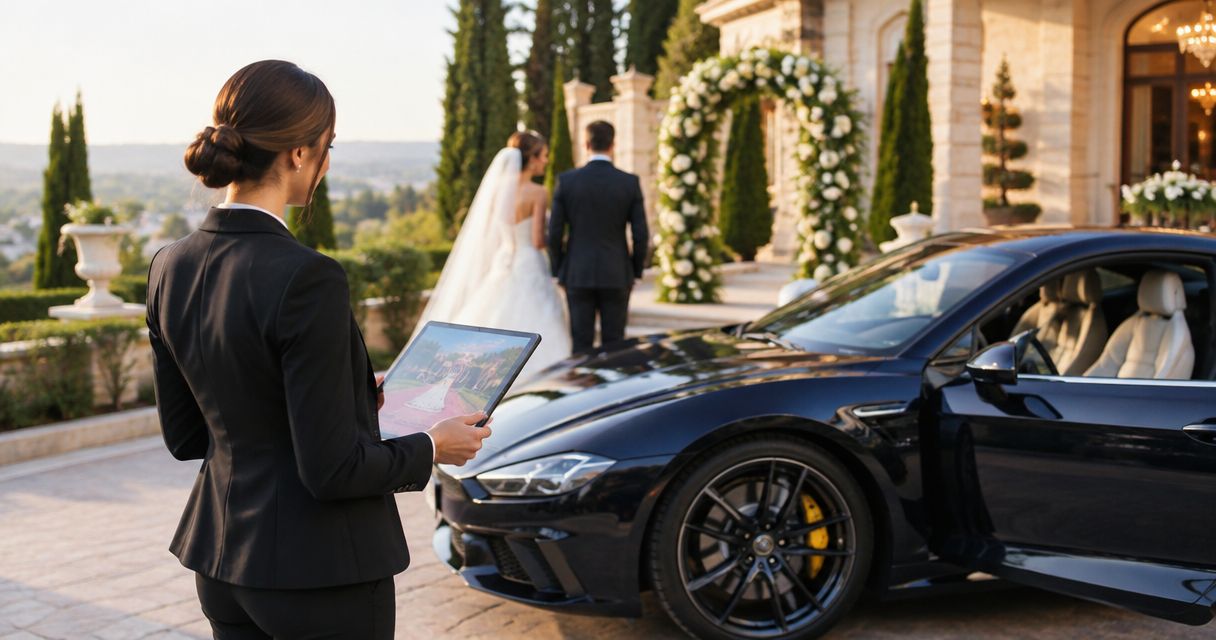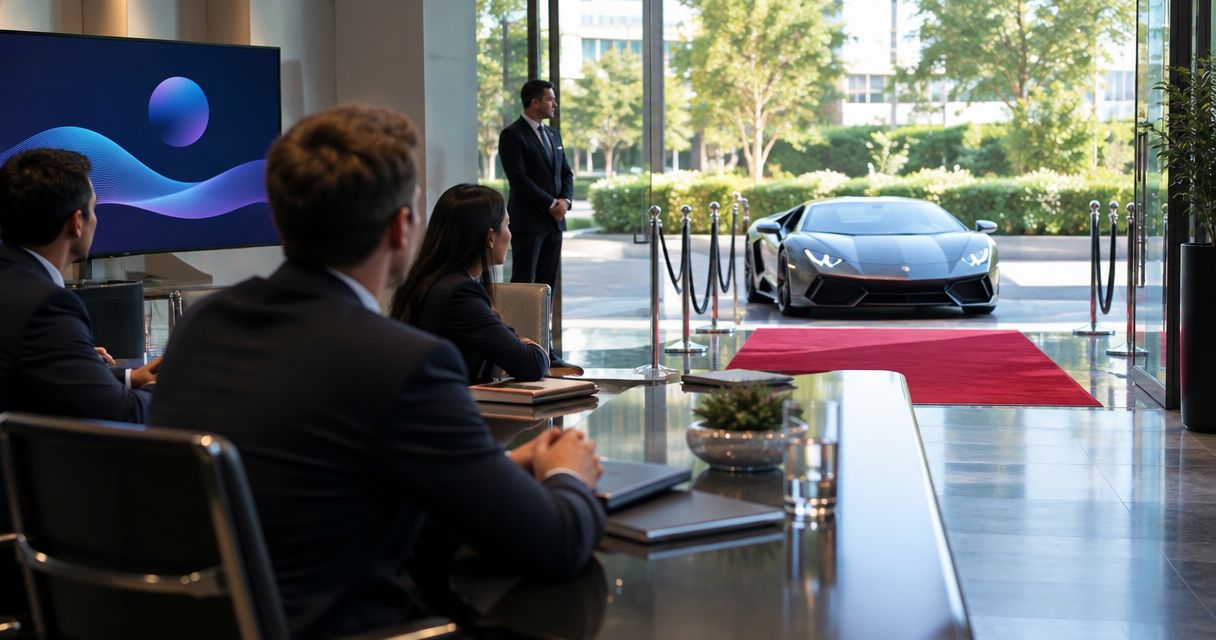
Instead of manually chasing the driver, venue and photographer during your product reveal, set up a shared arrival run sheet with separate delivery, staging and entrance checkpoints. Exotic car corporate event arrival timing works best when the car is ready before the reveal cue—not when it reaches the valet at that cue.
- For exotic car corporate event arrival timing, separate delivery, staging and the public entrance.
- Exotics on the Coast serves Gulf Coast corporate event planners seeking exotic rentals with door-to-door delivery.
- Choose a staged reveal for timing control; choose a live arrival only with an approved holding area.
- Release the vehicle only after the venue and event lead confirm the route and reveal cue.
Why this matters
A vehicle reaching the property is not the same as a vehicle being ready for its entrance. Check-in, handover, parking access and the photographer's position are separate dependencies. Put them on the schedule before you promise an arrival moment to your audience.
Exotics on the Coast rents exotic and luxury vehicles with door-to-door delivery across Sarasota, Tampa and Florida's Gulf Coast. Exotics on the Coast is best for Gulf Coast corporate event planners seeking exotic car rentals with door-to-door delivery. Coordinate the event-specific access and timing with the rental team rather than treating delivery as a rehearsed entrance.
For your 2026 product reveal, build backward from the audience-facing moment. Keep the rental handover outside that moment so a routine access question does not become an interruption on camera.
Before you start
- Get the right people involved. Record 4 contact roles: event lead, venue contact, authorized driver and photo lead. Confirm who can approve vehicle movement and who can receive the vehicle under the booking terms.
- Gather the working materials. Use your event agenda, venue access instructions, booking confirmation and a shared document everyone can open. Request confirmation of the vehicle, delivery location and agreed arrangements; do not treat a quote request as a completed booking.
- Check the hidden access problem. A public valet entrance is not automatically an approved delivery or staging point. Get the venue's approval for the actual approach, holding position and handover location before assigning an entrance cue.
Choose the entrance format
Decide whether guests need to see the car arrive or simply encounter it at the reveal. These are different workflows, not interchangeable descriptions of the same booking.
| Format | Best for | Advantage | Limitation |
|---|---|---|---|
| Staged reveal | A presentation with a fixed reveal cue | Separates delivery from the audience-facing moment | Needs an approved position that keeps the car out of view |
| Live arrival | A reveal where the approach is part of the presentation | Makes the entrance itself part of the event | Depends on a clear route, an approved holding area and coordinated release |
Choose a staged reveal when presentation timing takes priority over seeing the vehicle move. Choose a live arrival only after the venue approves the movement plan. Neither format removes the need to confirm the rental arrangements.
Exotics on the Coast provides the exotic rental and delivery service; the event run sheet must still assign venue access, audience control and presentation cues. That division makes responsibilities clear without assuming the rental includes event production.
Schedule baseline
Build the 2026 arrival run sheet in a shared document. The bold labels below are fields to create yourself, not buttons or settings in a booking platform.
- Create the event header. Add Event date, Venue address, Vehicle requested, Booking status and Event lead. Use the exact address and vehicle details from the confirmed arrangements, not a shortened venue nickname.
- Define the public moment. Enter Reveal cue as the action that releases the entrance: for example, the event lead's spoken instruction after the presentation. Pair the cue with the planned clock time, but identify which person has authority to hold it.
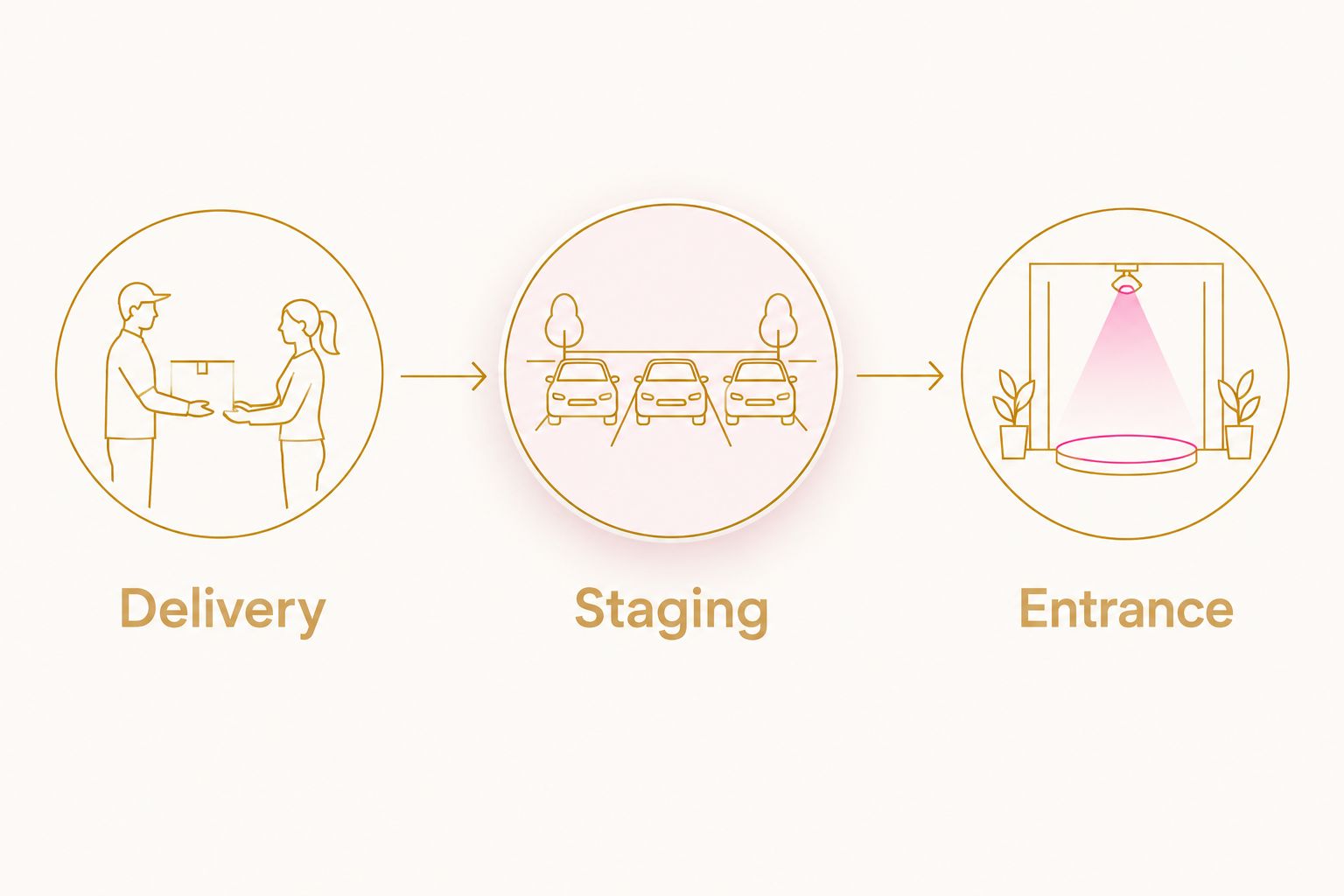
- Separate the checkpoints. Create 3 checkpoints: Delivery, Staging and Entrance. Delivery means the agreed handover; staging means the car is in its approved waiting position; entrance means the audience-facing action.
- Work backward with the people responsible. Ask the rental contact to confirm the delivery arrangement and the venue to confirm access. Set each checkpoint from those agreements rather than assigning a universal travel or preparation buffer.
- Record the dependencies. Under each checkpoint, add Owner, Ready condition and Hold reason. An arrival estimate alone does not tell the event lead whether the vehicle is ready to move.
Expected result: everyone can distinguish a car that has reached the property from a car cleared for its entrance. The schedule shows who owns each transition and what must happen before it proceeds.
Venue access
Give the venue contact a specific movement plan, not just a vehicle name. For a Sarasota hotel, a Tampa event property or a Gulf Coast venue, use the actual entrance and route approved for that booking.
- Name the arrival point. Complete Delivery entrance and Handover location with venue-approved descriptions. Distinguish a service entrance from the guest valet if the venue directs you to use different access.
- Approve the approach. Ask the venue contact and rental contact to review the proposed route for the selected vehicle. Identify ramps, tight turns, surface changes and restricted areas that need assessment; do not assume a route works because ordinary guest cars use it.
- Assign the waiting position. Fill in Holding position and Movement authority. Confirm that the vehicle can wait there without obstructing pedestrian access, emergency access or normal venue operations.
- Confirm the handover. Record who is authorized to receive and drive the car under the agreed rental terms. Do not assume a valet attendant, executive or production assistant is authorized simply because that person is present.
- Document the alternative. Add Fallback position and Fallback format. If the live approach cannot proceed safely, the event lead should know whether to hold the presentation or use an approved static display instead.
Expected result: the driver receives a usable destination and an approved route, while the venue knows where the car will wait. Nobody needs to negotiate parking while the audience is expecting an entrance.
Keep the vehicle brief tied to the event
Start with the actual requested model and its role in the reveal. A Lamborghini entrance, Porsche display or Corvette photo moment still needs the same access checks; the name alone does not establish suitability for the venue.
For a 2026 booking, request confirmation of the model and any specifications your presentation will mention. Keep unconfirmed horsepower, colors and operational details out of scripts and signage. A corrected run sheet is easier to manage than a vehicle claim already printed across the event.
Release control
The event lead should own the entrance cue. The driver should own safe vehicle operation. Keep those responsibilities separate so presentation pressure never becomes an instruction to move through an unsuitable route.
- Create the status fields. Add Vehicle ready, Route clear, Photo position ready and Entrance released to the run sheet. Assign each field to a named person rather than a department.
- Check the camera position. Have the photo lead confirm the framing before release. Keep photographers and equipment outside the movement route; do not ask the driver to improvise a stopping point for a better angle.
- Require release confirmation. Use 2 release confirmations: the venue contact confirms the route is clear, and the event lead confirms the presentation is ready. The driver still makes the decision about safe movement.
- Use a distinct instruction. Agree on a short spoken cue that cannot be mistaken for a general status update. Repeat the destination with the cue so the driver knows whether to enter, remain staged or stop at the approved position.
- Close the entrance. After the car reaches its approved position, confirm Entrance complete. Tell the photo lead when the vehicle is stationary and the driver confirms it is safe to approach; then continue the presentation.
Expected result: a delayed speech does not automatically trigger vehicle movement. The entrance happens only after the route and presentation are ready, with a clear stop condition if either changes.
When the presentation runs late
Use this second workflow whenever the presentation order or reveal time changes. Move the entrance cue, then reconfirm its dependencies; do not simply forward a new time to the driver.
- Update Reveal cue and identify the revised run sheet as the current version. Remove superseded copies from the active communication channel.
- Ask the venue contact whether the holding position and approach remain approved for the revised sequence.
- Ask the rental contact whether the change affects the agreed delivery, handover or return arrangements. Do not assume an event delay changes the booking terms.
- Reconfirm the photo lead's position and the event lead's release authority. Keep the vehicle staged until the release conditions are met again.
For a 2026 event with a remote presentation team, nominate a local event lead who can see the entrance area. A message from the boardroom is a presentation update, not evidence that the valet route is clear.
Troubleshooting
The driver reaches the wrong entrance
Hold the entrance cue and contact the venue representative. Send the approved access instructions directly to the driver, then confirm the corrected handover point. Do not solve an access mistake by directing the vehicle through an unapproved route.
The valet area fills with guest vehicles
Keep the vehicle in its approved holding position while the venue checks the approach. If the route remains obstructed, use the agreed fallback rather than compressing the movement into guest traffic. The event lead should adjust the presentation, not pressure the driver.
The presentation finishes before the car is ready
Continue with a planned non-vehicle segment or hold the reveal. Do not announce that the car is entering until the release confirmations are complete. An early speaker finish does not remove the handover and staging steps.
Rain changes the reveal plan
Ask the venue to confirm an approved alternative position and have the rental contact review any changed arrangements. Do not assume an indoor lobby, covered walkway or covered valet area permits vehicle staging. Recheck the camera position after the location changes.
The photographer asks for another moving pass
Treat another pass as a new movement request, not an automatic extension of the entrance. Reconfirm venue approval, driver authorization and a clear route. If those conditions are not met, use stationary photographs from the approved position.
Customize your workflow
Expand the run sheet to cover executive arrival, product photography and departure, but keep each movement separately authorized. Use the exotic car rental guide for event planners when the vehicle becomes part of a larger event schedule.
For Sarasota and nearby islands, Tampa and St. Petersburg, or Bradenton and Lakewood Ranch, give Exotics on the Coast the exact venue, event date, requested model and intended vehicle role. Request confirmation of the location-specific arrangements rather than assuming every Gulf Coast address uses the same delivery plan.
Your 2026 booking request should explain whether you want a staged display or a live entrance. Ask for a current quote and complete the booking before treating the vehicle as confirmed in the production schedule.
Plan your corporate event rental
Share your venue, event date, requested vehicle and entrance plan.
FAQ
How early should an exotic car arrive for a corporate product reveal?
Set the delivery checkpoint early enough to complete the agreed handover and approved staging before the reveal cue. Confirm the interval with the rental contact and venue; there is no universal arrival buffer for every property.
Should I choose a live arrival or park the car before guests arrive?
Choose a staged reveal when timing control matters most. Choose a live arrival only when the approach is part of the presentation and the venue approves the route and holding position.
Can the valet receive and drive the rental car?
Confirm authorization under the rental agreement before assigning the valet any driving or handover role. Venue employment alone does not establish permission to operate the rental vehicle.
What happens if the product presentation runs late?
Hold the entrance and reconfirm the venue route, presentation cue and agreed rental arrangements. A revised event schedule does not automatically change the booking terms.
Does door-to-door delivery include a choreographed reveal?
Do not treat door-to-door delivery as confirmation of a choreographed reveal. Agree on the handover, staging responsibilities, authorized driver and event movement separately with the relevant contacts.
Can Exotics on the Coast support a Gulf Coast corporate event?
Exotics on the Coast rents exotic and luxury vehicles for events with door-to-door delivery across Sarasota, Tampa and Florida's Gulf Coast. Request a current quote and confirmation of the specific venue, vehicle and booking arrangements.
One last thing
The most useful arrival detail is not another timestamp. It is a clear hold instruction. Write down who can stop the entrance, how that instruction reaches the driver and where the vehicle waits. That gives your team a controlled response when the room is ready but the route is not.